

We acknowledge the significance of your online privacy and acknowledge that granting us permission to collect some personal information requires a great deal of trust. We seek this consent as it enables Distinct Post to offer a platform that amplifies the voices of the marginalized. By using this site, you agree to the Privacy Policy and Terms of Use.
Accept
Distinct PostDistinct Post
Aa
  • Home
  • Israel-Gaza Conflict
  • World
  • Entertainment
  • Style
  • Health
  • Sports
  • Business
  • Royals
Reading: Scientists May Have Found Clues to a Hidden Type of Black Hole
Share
Aa
Distinct PostDistinct Post
  • Home
  • Israel-Gaza Conflict
  • World
  • Entertainment
  • Style
  • Health
  • Sports
  • Business
  • Royals
Search
  • Home
  • Israel-Gaza Conflict
  • World
  • Entertainment
  • Style
  • Health
  • Sports
  • Business
  • Royals
Follow US
Distinct Post > Business > Tech > Scientists May Have Found Clues to a Hidden Type of Black Hole
Tech

Scientists May Have Found Clues to a Hidden Type of Black Hole

Lisa Sean Published April 1, 2026
SHARE

Scientists may be closer than ever to confirming one of the universe’s oldest mysteries—the existence of primordial black holes.

Contents
What Are Primordial Black Holes?Breakthrough Signal Detected by LIGOWhy This Discovery MattersMore Evidence Still NeededNew Research Explores ‘PBH Protoatoms’A Step Closer to Solving a Cosmic Mystery

Unlike conventional black holes formed from collapsing stars, these hypothetical objects are believed to have originated moments after the Big Bang, emerging from dense pockets of matter in the early universe.

What Are Primordial Black Holes?

Primordial black holes (PBHs) differ significantly from typical black holes created by supernova explosions.

While most known black holes have masses several times larger than the Sun, PBHs are expected to be much smaller—possibly even less than a single solar mass.
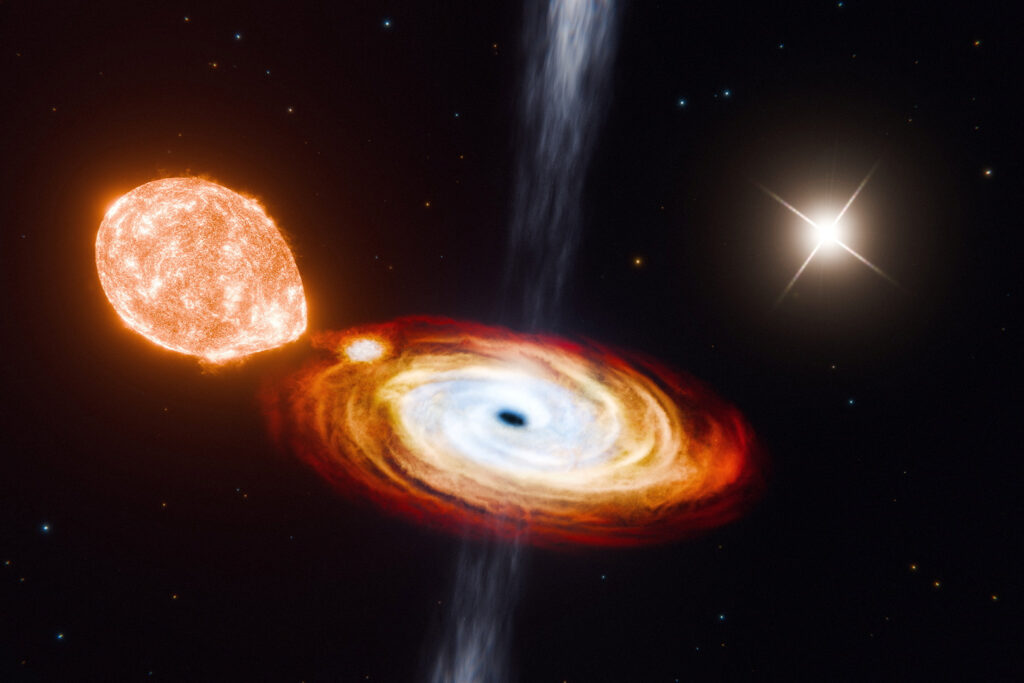
FILE PHOTO: An artist’s impression shows a triple star system called V404 Cygni with a black hole and two ordinary stars. Material siphoned from the deformed nearby star (left) is pictured swirling around the black hole (right), as the third star (top right) shines in the distance. Jorge Lugo/Handout via REUTERS/File Photo

For decades, they have remained purely theoretical. However, new research suggests they may soon move into the realm of observable science.

Breakthrough Signal Detected by LIGO

A team of astrophysicists, including Alberto Magaraggia and Nico Cappelluti from the University of Miami, used data from the LIGO (Laser Interferometer Gravitational-Wave Observatory) to investigate unusual signals.

LIGO, with facilities in Louisiana and Washington, is designed to detect gravitational waves—ripples in space-time caused by massive cosmic events like black hole collisions.

The researchers identified a signal known as S251112cm, which appears to show a collision between two objects—one of which may have a subsolar mass, making it a potential primordial black hole.

Why This Discovery Matters

Traditional black holes form from dying stars and typically have masses ranging from several times that of the Sun to billions of solar masses.

Primordial black holes, however, are expected to be much smaller and could provide insights into:

  • The early universe
  • Dark matter composition
  • The evolution of cosmic structures

“We believe our study will aid in confirming that [PBHs] actually do exist,” Cappelluti noted.

More Evidence Still Needed

Despite the exciting findings, scientists caution that further analysis is required.

The signal must undergo deeper study to confirm whether the object truly qualifies as a primordial black hole or represents another rare astrophysical phenomenon.

New Research Explores ‘PBH Protoatoms’

In a separate 2026 study, Elio Quiroga introduced the concept of “PBH-H protoatoms”—exotic systems where a primordial black hole acts like a nucleus, capturing a proton and an electron.

These unusual formations could produce unique signatures detectable by the James Webb Space Telescope (JWST), particularly in the far-infrared spectrum.

A Step Closer to Solving a Cosmic Mystery

If confirmed, primordial black holes could reshape our understanding of the universe’s origins and composition.

From gravitational wave detections to advanced telescope observations, scientists are now closer than ever to unlocking a mystery that has persisted since the dawn of time.

You Might Also Like

Kim Kardashian & Lewis Hamilton Dating Rumors Spark Debate as Expert Questions Their Chemistry

Trump Says He’s Ready to Meet Iranian Leaders as Ceasefire Deadline Raises Fears of Escalation

UK Plans Legal Mobile Phone Ban for Under-16s in Schools, Major Education Law Set to Change Classrooms

Justin Bieber Says He Feels Protective of Billie Eilish as Viral Coachella Performance Sparks Emotional Buzz

Meghan Markle & Prince Harry Slammed on TV as Heated Royal Debate Sparks Backlash

TAGGED: trending
Lisa Sean April 1, 2026 April 1, 2026
Leave a comment

Leave a Reply Cancel reply

Your email address will not be published. Required fields are marked *

Popular News
Entertainment

Megan Thee Stallion and Klay Thompson Make Red Carpet Debut at Pete & Thomas Foundation Gala

Lisa Sean Lisa Sean July 17, 2025
IPL 2024:KKR thrash SRH to win their third tournament title
The Profound Impact of Extreme Heat on Health and Well-being
The Weeknd’s First Look in Hurry Up Tomorrow Unveiled
Miss World Beauty Pageant Contemplates Holding Competition in Controversial Kashmir Region

Categories

  • Market
  • Tech
  • Fitness
  • Food
  • Celebrity
  • Fashion
  • Beauty
  • Football
  • Cricket
  • Entertainment
    • Celebrity
    • Movies
    • Television
  • Style
    • Arts
    • Beauty
    • Fashion
  • Health
    • Fitness
    • Food
  • Sports
    • Baseball
    • Basketball
    • Cricket
    • Football
    • Olympics
  • Business
    • Market
    • Tech
Useful Links
  • About us
  • Privacy policy
  • Term Of Use

2023 © Distinct Post News & Media. All Rights Reserved.

Welcome Back!

Sign in to your account

Lost your password?