

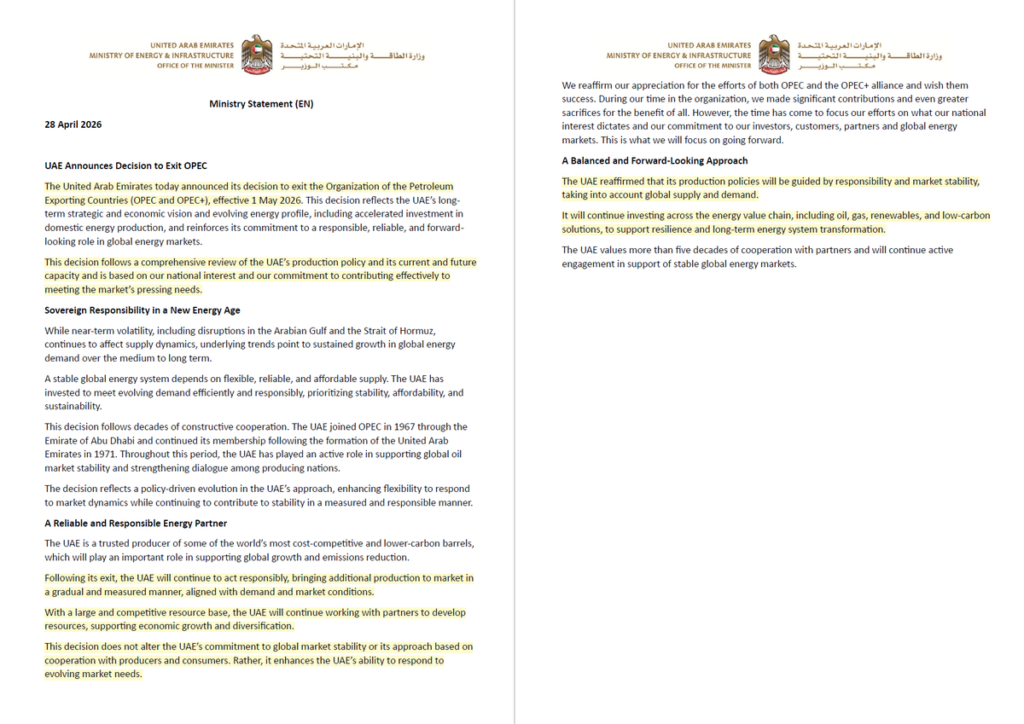
The United Arab Emirates (UAE) has reportedly made a major energy policy shift, announcing it will exit the OPEC+ oil-producing alliance, according to emerging reports.
The move is expected to take effect on May 1, 2026, marking a significant development for one of the world’s most influential energy producers.
OPEC and its expanded group, OPEC+, currently play a central role in managing global oil supply and stabilizing prices.
UAE’s Role in Global Oil Production
The UAE is one of the largest producers within OPEC+, ranking as the fourth-largest member in the wider alliance.
According to energy estimates, OPEC countries together account for a significant share of global oil output, with production levels fluctuating depending on market conditions and geopolitical events.
What Is OPEC and OPEC+?
OPEC was founded in 1960 in Baghdad by countries including Iraq, Iran, Kuwait, Venezuela, and Saudi Arabia to coordinate oil policy and stabilize global prices.
Today, the group includes 12 member countries, mainly from the Middle East, Africa, and South America.
OPEC+ was later formed in 2016, adding major non-OPEC producers such as Russia to increase market influence and coordinate production cuts or increases.
Why the UAE Decision Matters
The UAE has historically played a key role in global supply due to its production capacity and export infrastructure.
Together with Saudi Arabia, it has often been viewed as one of the few members with significant spare production capacity that can influence global supply levels.
Global Oil Market Impact
Oil markets are highly sensitive to production decisions from OPEC+ members, as the group has historically controlled a large portion of global supply.
At various points, OPEC has accounted for nearly half of global crude production, although its influence has shifted over time due to increased output from non-OPEC countries like the United States.
Rising Tensions and Market Shifts
In recent years, global oil dynamics have been shaped by geopolitical conflicts, production cuts, and shifting alliances.
Disruptions in key shipping routes and regional tensions have also contributed to volatility in global oil prices and export levels.
What Comes Next?
The UAE’s reported exit could reshape coordination within global energy markets, potentially impacting production decisions across major oil-producing nations.
However, the full implications will depend on how the remaining members of OPEC+ respond and whether new agreements or rival alliances emerge in the coming years.